
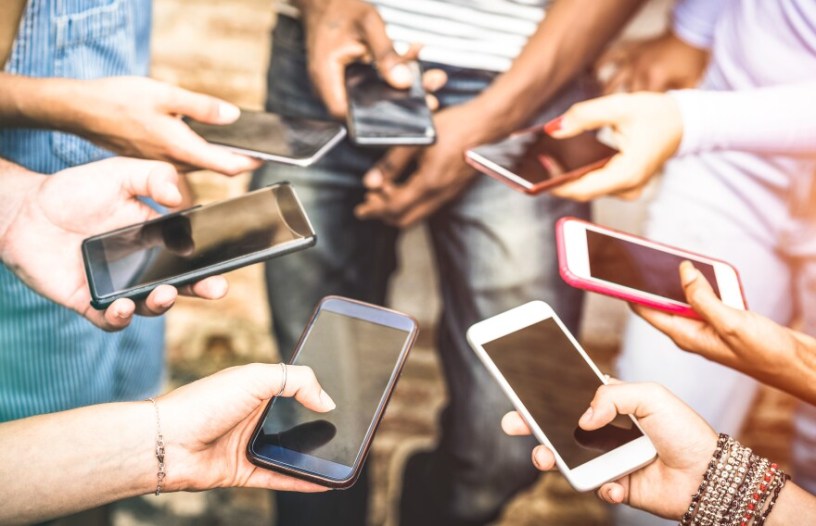
North Carolina has introduced a statewide law requiring schools to restrict student cellphone use during school hours. The state law says students must now keep their phones off during school hours except for educational or medical reasons or in emergencies.
However, the Transylvania County school board has created a local policy that requires phones to be off from 8 a.m. to 3:05 p.m. each school day, with no exception for educational use.
“Brevard High is very strictly enforcing this policy,” said Principal Mick Galloway, with only six phones being confiscated and returned by Sept. 3. BHS is mandating the policy, with a specific list of consequences for being caught with a phone.
The first offense for being caught with a cellphone anytime during the school day is having the phone taken. The student must pick it up at the end of the day from the front office. A second offense results in the phone being taken away, and a parent or guardian must pick it up at the end of the day.
For the third offense, the phone is taken away again and students receive two to three days of in-school suspension.
Galloway said the phone policy comes with a lot of merits. If he had a say in it, however, he would allow phones during class transitions and at lunch. He said he understands that many students have younger siblings, work schedules and other responsibilities they may need to check on.
Staff and admin have only confiscated a total of six phones since the start of the school year on Aug. 25 through Sept. 9.
“Out of 807 students, here for eight hours a day, six phones is way better than expected. Students are doing a great job following the policy,” said Galloway, who added that previously, if a teacher asked a student to put their phone away, the student would comply.
“We have very respectable students here,” Galloway said. In the 13 years he has been at Brevard High, Galloway said he has taken fewer than four phones.
He emphasized that the policy is a state law and they are required to abide by it.
Choir teacher Charles Burchill says the policy was initially “quite an adjustment.” He says it can get in the way of some of his assignments that he has for students, which is difficult.
“I like that it’ll encourage people to interact more; it probably will help students be more engaged in classes. I also think that it will reduce social media use and cyberbullying during the school day,” he said.
“I don’t like that it seemed sudden, like it went from 100% fine to 0% fine; also, it was sometimes an excellent tool. I wouldn’t have done it this way.”
Although he wishes there was a better way for students to communicate with their parents, he said he believes that by the end of the school year, we will see a positive impact.
English teacher Meredith Licht had mixed feelings about the policy. She believes phones can be a problem in classrooms and students can be distracted by them. She also thinks the change is affecting the school positively because students are engaging more with their peers.
“I know there’s a lot of research that phones lead to things like anxiety, and that there are negative outcomes for students,” she said. “One thing I do like about it is that students seem to be less distracted and that’s really helpful for classroom management.”
Like Burchill, she also believes that phones can be an educational tool.
“Something I dislike about it is particularly the restriction on headphones, because they use things like EdPuzzles, for example,” Licht added. “They did not need to make the policy as restrictive as it is.”
Daisie Hullender, who teaches French, believes that “the phone ban is slightly overkill, but I do think that it is beneficial for students who have a problem with putting their phone down for instructional time.”
She said the policy will be harder to regulate during lunch and transitions. Something Hullender likes about the phone ban is that students are more willing to communicate with each other during brain breaks, and they are also more willing to make friends.
Hullender dislikes that whenever a student needs to call a parent or guardian, a lot of times they do not know the number or they struggle to use the school phones.
“I think it has a semi-positive effect for certain students, but I think other students can limit their own screen time,” she said.
From a teacher’s perspective, it feels like a good idea, especially for instructional time, she added. She has fewer issues with students trying to pull phones out.
Senior Cheyenne Pressley says, “The new county policy really undermines the lives of us students. We have busy lives, jobs, families, siblings that we have to care for. Also, without being able to use it for academic purposes, even though we have chromebooks, they don’t always work.
“I feel like we are in the digital age that we do need our phones for school sometimes. For me specifically, I’m taking online American Sign Language classes and my Chromebook does not properly process the material I need to complete. I sometimes need to use my phone so I am now not able to complete that portion of my education.”
She also said she understands it’s school time, but it’s the majority of a student’s day, and phones are a part of their lives.
“I don’t think it’s a horrible thing and I understand the efforts; I am happy to see more people talking and really connecting with each other, but I’m not a fan of how our county is enforcing it.”
Senior Leon Saucier says the policy is a “broken solution,” adding, “I’m a believer that a lot of the issues with the phones that we have are a self-control issue.”
Saucier said the policy negatively affects students and clubs, which used phones for marketing and social media, such as the Thespian and gaming clubs.
“Some of the stuff we did in class, or in yearbook (class), for example, used social media to make money,” Saucier added.
Phones should be allowed during lunch, Saucier said.
“I think that it’s (the policy) is not gonna stop a lot of people – if people want to get around the policy, they will,”
 The Broadcaster